Origins
The origins of Australia’s Wonderland can be traced to William (Bill) Hanna, co-founder of the Hanna-Barbera animation studio responsible for Yogi Bear, Fred Flintstone and Scooby-Doo. Hanna had a long association with Australia, having set up an Australian animation division at Crows Nest in Sydney more than a decade before Wonderland opened, and he believed Sydney could support a large, world class theme park. His enthusiasm helped generate interest among investors, and market research pointed to strong demand for a major family entertainment attraction.
With a capital injection of $65 million, Wonderland began life in December 1985 with the financial backing of the NSW State Superannuation Board (33.75%), James Hardie Industries (23.75%), Leighton Holdings (18.75%) and Taft Broadcasting (23.75%). The initial goal was to capture the family entertainment market in Sydney with the trial of an American-style theme park for Australia.
Taft, which owned Hanna-Barbera, was the managing partner, and the Kings Entertainment Company managed the park on Taft’s behalf. Kings already ran major theme parks in North America, including Canada’s Wonderland and Kings Island in Ohio, and was described at the time as the second largest operator of themed amusement parks in the world. Keith James was Wonderland’s Managing Director during its development and early operation.
Keith James began his career in 1971 at Kings Island in Cincinnati, co-founded King Productions, Taft’s design and entertainment division, in 1974, became director of planning and development at Canada’s Wonderland in 1979 and its director of operations in 1981, and in mid 1983 was appointed managing director of Australia’s Wonderland.
With backing from the State Government, Wonderland’s site at Eastern Creek (then still considered Minchinbury) was easy to obtain with full support from Blacktown Council citing the employment and tourism opportunities it would bring to the area. This location was chosen to be central to urban sprawl predicted to spring up within 20 years and a prime location alongside the M4 motorway being the major arterial freeway into Western Sydney.
Many rides, such as the Bush Beast, Beastie and Zodiac, were sourced second-hand from the Kings parks or were replicas of rides already there, and the theming of Wonderland, especially Hanna-Barbera Land, was based directly on Canada’s Wonderland.
Planning and construction
The site covered about 219 hectares near the junction of Wallgrove Road and the F4 Freeway, now the M4, at Minchinbury, later more often described as Eastern Creek. It was largely pasture with stands of established trees. The land was zoned for entertainment and tourism on 4 November 1983, and development consent for Australia’s Wonderland was granted on 1 March 1984.
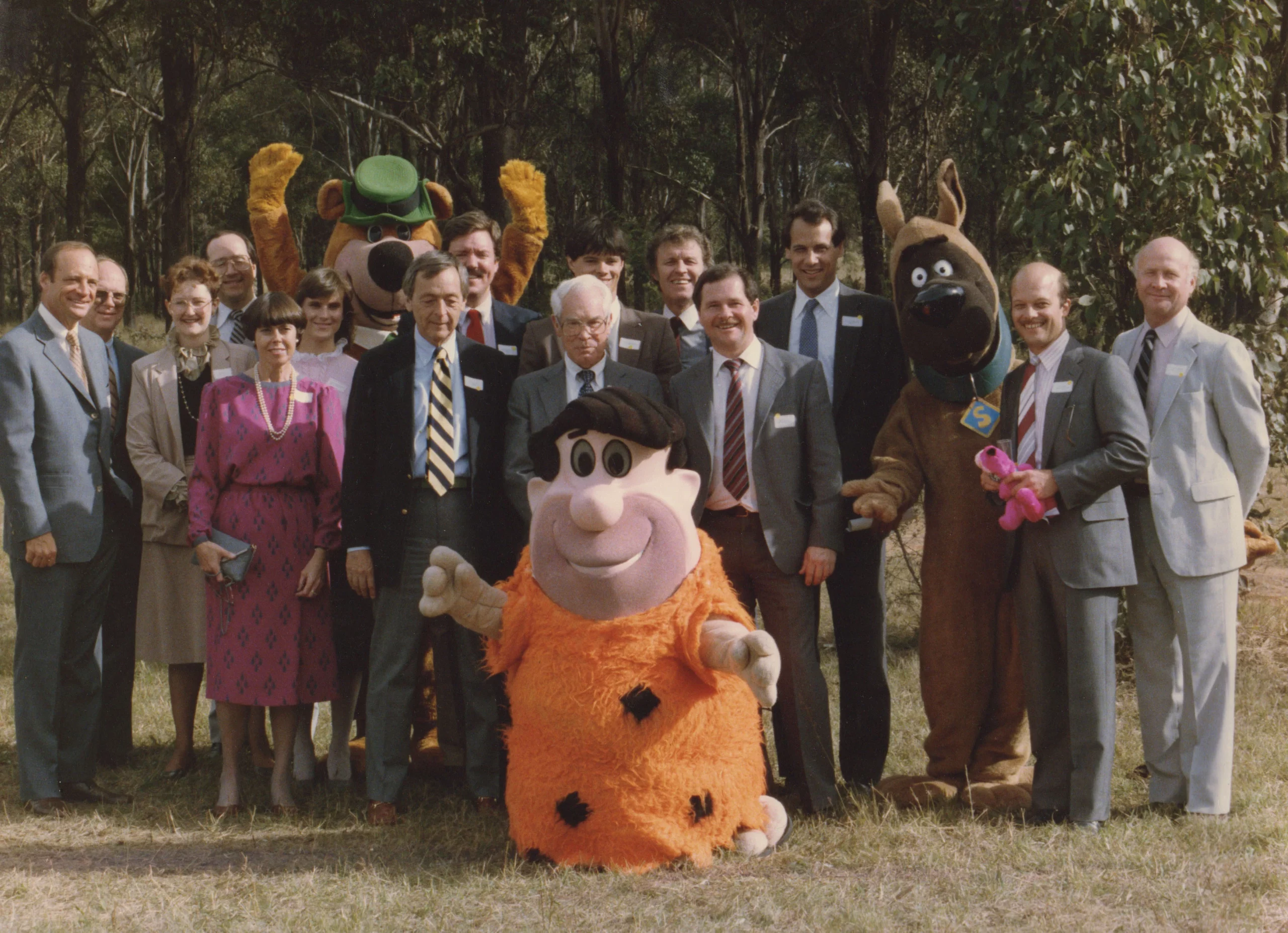
On 8 June 1984 NSW Premier Neville Wran officially launched the project at a groundbreaking ceremony on the site, attended by Bill Hanna, representatives of the partners and several Hanna-Barbera characters. Construction began that month and created nearly 500 jobs in Western Sydney. Over the following 18 months the paddocks were transformed into a theme park of themed buildings, major rides, landscaped gardens, waterways and entertainment venues. One of the largest single jobs was the car park, about 30 hectares laid out for 6,000 vehicles.
Opening and the early years
Wonderland’s official opening was on 7 December 1985, where Premier Neville Wran turned on the park’s waterfall alongside Yogi Bear to signal its opening. Premier Wran was then escorted around the park by Managing Director Keith James and Kings Entertainment Co-President Nelson Schwab. Also present at the opening ceremony was Hanna-Barbera co-founder Bill Hanna.
Australia’s Wonderland was open daily from 14 December 1985 except Christmas Day, from 9 am, then weekends and most school and public holidays from February, closing from mid May to mid August 1986.
2 photos on this page
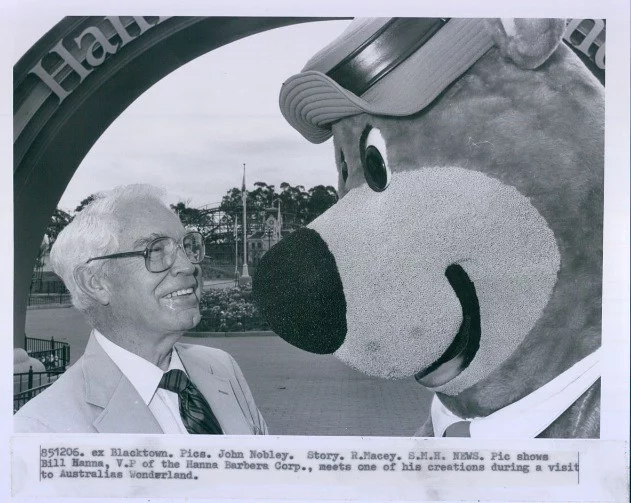
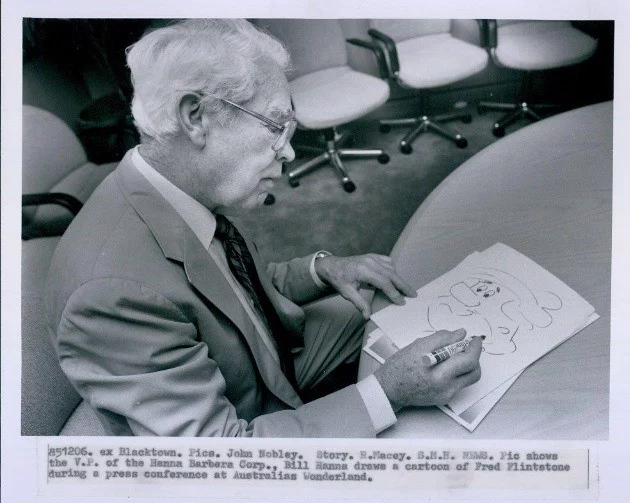
Promoted as the largest theme park in the Southern Hemisphere, Australia’s Wonderland was planned as a complete family entertainment destination rather than a collection of rides. It opened with three themed lands, Goldrush, Medieval Faire and Hanna-Barbera Land, each with its own attractions, entertainment, restaurants, shops and games. Admission was pay one price: the ticket covered the rides and live entertainment, with food, merchandise and games charged separately. The early souvenir guide advertised the ticket booths and gates opening at 9 am, rides and shows from 10 am and closing at 8 pm, though hours varied over the years.
Live entertainment was central to the original concept: pirate stunt shows aboard the Tooheys Tall Ship, The Buccaneer, musical productions at the Gold Nugget Theatre, character shows in the Hanna-Barbera Theatre and puppet shows at the Gumtree Theatre. Guest services included first aid, security, lockers, stroller and wheelchair hire and a Kodak service that lent visitors a camera for the day.
Direct competition at the time was with Luna Park and, to a lesser degree, Mt. Druitt Waterworks. Attendance figures were projected to be around 1.6 million people in the first year, but by August 1986 Wonderland had fallen quite short with only 600,000 visitors walking through the gates of the park.
The Hanna-Barbera theme played a large part in Wonderland with Hanna-Barbera Land being an easily recognisable part of the park. It was criticised early on for being based on very outdated cartoons and American “hand-me-downs”, yet was a hit with children and parents alike.
The three themed lands and their evolution
Originally Wonderland started with just three themed lands: Medieval Faire, Goldrush, and Hanna-Barbera Land. Medieval Faire was later renamed International Village when rides originally placed there (such as the Sea Demon) were relocated. The Sea Demon is better known as HMS Endeavour. The addition of other attractions did not fit with the original medieval theme and also contributed to the renaming to International Village.

One of the most unusual construction jobs in Medieval Faire was The Buccaneer, the Tooheys Tall Ship, which was built in Granville, loaded onto two semi-trailers and transported into Wonderland in the early hours of the morning along Parramatta Road and the Great Western Highway. About 18 metres long with masts 20 metres high, it cost about $350,000 and took six months to build. Sponsored by Tooheys, in its prime it featured a stunt show with regimental soldiers and pirates duking it out, performed five times a day in the early years. Marketing by the park prominently used this stunt show in its advertisements, and you may remember television ads in the late 80s and early 90s featuring footage from this show (remember the pirate falling off the mast?).
With the introduction of Transylvania in 1992, rides and attractions from the International Village were yet again relocated, and the area was finally renamed Old Botany Bay. The Sea Demon was renamed HMS Endeavour in 1990 and moved into Goldrush. The Jousting Ring and Bountys’ Revenge were the only rides remaining in Old Botany Bay.
Expansion and change
Over the next decade Wonderland developed steadily, much like any other theme park. It is well known in the amusement industry that for any theme park to succeed, capital injections must be made every 2-3 years which are used for the purchase of new attractions. Wonderland was no different, and the most high-profile rides that were installed in the park after its initial construction were The Demon (1992), Space Probe 7 (1995) and The Beach (1988).
The mid 1990s brought the NSW Tourism Awards for Excellence 1994 Award of Distinction and the 1995 Tourism Distinction Award. By September 1995 the park had cost $100,000,000, was the largest employer of youth in the western suburbs with 900 seasonal and 110 full time staff, and was about to expand to 364 days a year from the following March. Space Probe 7 opened in 1995 under a naming rights deal with Channel Seven, and the Outback Woolshed with its two restaurants opened the same year.
The Beach water park opened in 1988 as a major seasonal attraction beside the theme park, and the Australian Wildlife Park followed in 1990, bringing native animals to the site and another drawcard for international tourists. The Demon roller coaster arrived in 1992, the year Taft Broadcasting’s interest in the park was sold to Australian investors. Space Probe 7 and the Outback Woolshed and its restaurant were introduced in 1995. Under Sunway, which acquired the park in 1997, the layout, attractions and branding changed again and the park became known as Wonderland Sydney; the Skyrider cable car, installed in 1997, was the last major ride added before the closure.
By 2003 the park had welcomed over 18 million guests since 7 December 1985, its three lands had grown to six, it had become Wonderland Sydney in 1997 and it ran 365 days a year. It held the record crowd for any Australian theme park, over 23,000 at a Halloween function in 1992, and drew its biggest crowd in five years, over 14,000, on Monday 3 December 2001. Wonderland Sydney won the Major Tourist Attraction award at the 2002 NSW Tourism Awards for Business Excellence, was runner up in 2003 and held two IAAPA Brass Ring awards for marketing. The year of the name change is given as 1997 in some places and 1998 in others, so it is not settled.
Decline and sale
A grand plan for Wonderland’s future was that the 219 hectares of land that it sat on would be further developed into a larger resort with golf course, separate waterworks area (which became The Beach), accommodation and parkland. It is conjecture and rumour that Rooty Hill RSL strongly opposed this development, claiming that it would harm its interests in the area. Hence, zoning changes that would have been required to make these visions possible never did occur.
It is at this point that pundits believe led to Wonderland’s decline. So critical were these developments that investors in Wonderland came to the stark realisation that their investment would go nowhere, especially after the initial support from Blacktown City Council and the State Government. After having incurred losses of $15 million and having the park’s success slowly decline, Wonderland was sold in 1997 to the Kuala Lumpur-based unit trust, Sunway Australia. Sunway Australia bought all the founding shareholders’ stakes and the management company, Sydney Theme Park.
From the time Sunway took over and until the park’s closure the only major attraction added was the Skyrider. It is often claimed that the park was run on “remote control” with the parent company indifferent to any real development of the park. Much debate is had as to the real reason why Sunway purchased Wonderland, but the most popular reasons are either a clumsy attempt at cashing in on the Australian tourism market or, more sinister, the intention to let the park decline and cash in on the land. Both of these theories are extremely plausible.
The closure of Wonderland Sydney
On 16 February 2004 staff were told that Wonderland Sydney would close for good. The announcement came amid concern about the park’s finances and difficult tourism and economic conditions; management pointed to declining international tourism, rising insurance costs, the September 11 attacks and the SARS outbreak. At the same time the sale of the property for $52.5 million was announced, with the site to become an industrial business park.
Wonderland Sydney operated for the last time on 26 April 2004, ending more than 18 years of operation. The rides, buildings and equipment were progressively dismantled, demolished or sold and the site was redeveloped for industry, although surviving photographs, documents, memorabilia and relocated attractions continue to preserve the history of Australia’s Wonderland.
Got a Wonderland story or photos to share?
Join us on Facebook - share memories, photos and stories of Australia's Wonderland with thousands of other fans.
Join Wonderland History on Facebook →