In late 1995 a new landmark rose from the ground at Australia’s Wonderland: Space Probe 7. SWR-FM approached Wonderland and gained a handshake agreement to install some temporary broadcast equipment in the probe and conduct a test.
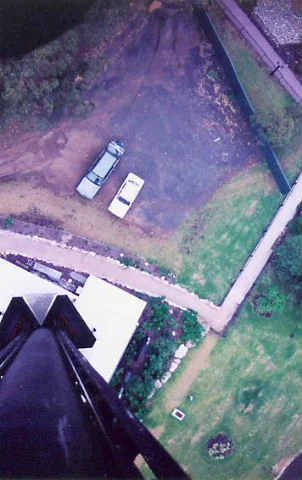
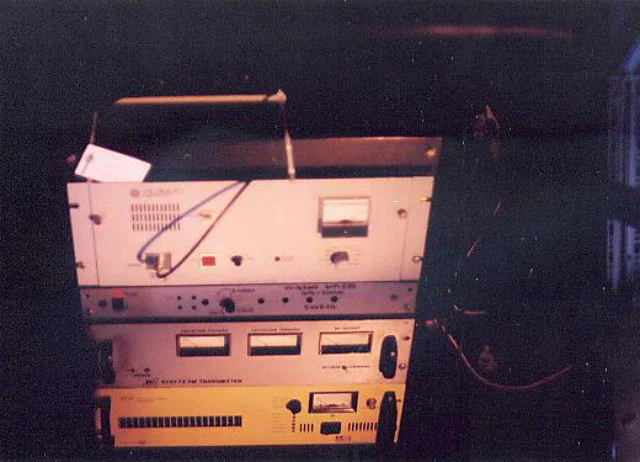
One limitation was the type of antenna the station could use. It was limited to a co-linear (whip) antenna so as not to detract from the look of the probe. A few weeks later the heavy equipment was hauled 75 metres up inside the probe by the station’s technical team, installed, and switched on in November 1996.
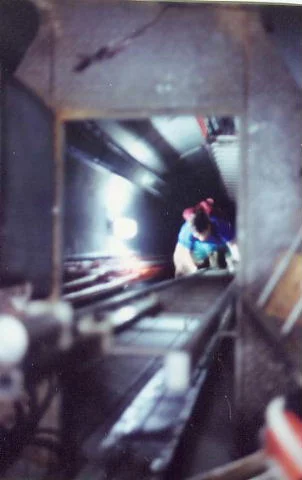
SWR-FM’s coverage improved dramatically, especially in the Blacktown CBD. Only a few months later the failures began. One by one the transmitter, RF amplifier and UHF receiver failed, and then failed again and again in the damp, corrosive environment at the top of the tower. Every failure meant a 75 metre climb straight up with a heavy piece of gear in tow. As a result SWR was often reduced to low power transmissions from the probe.
Throughout 1997 the problems sapped the technical committee’s time. In September 1997 the committee spent ten hours one night hauling up new enclosures for the equipment and re-installing it in a safer, more permanent fashion in the hope that the problems would be solved. Instead the problem became the management of Wonderland itself, which claimed that the alterations had not been authorised when in fact they had been, months before. In the intervening time the management of Wonderland had changed no less than eight times. The temporary deal was over and SWR was off the air from the probe.
5 photos on this page
The probe’s sound system
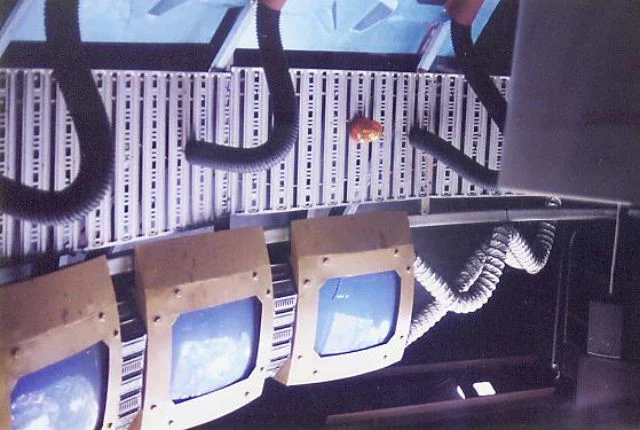
The photo taken under the hat also shows part of the ride’s sound system. In the lower right corner of the picture of the TV monitors is a speaker, with a second, blurred speaker below it. Six pairs of these sat either side of the cabins and replayed the countdown. The speaker in focus is a Martin C15, a very loud 5 inch speaker; the one below it is a 10 inch Canon sub-woofer in a quadrant-shaped cabinet, not very efficient but it looked the part. The same speakers were used in the pre-show room that riders were ushered into from the third tunnel of the entrance.
The C15s were also used around the launch pad, configured as six stereo pairs, with three Martin subs hidden behind the corner facades. The launch pad sound effects were driven by an Akai S720 sampler. Custom software triggered the sound samples via MIDI and delayed them across each pair of speakers to produce a soundscape that travelled 360 degrees around the pad. In the system tests before the ride opened, sound pressure levels of around 115 dB were measured; the system was never allowed to run that loud during operations.
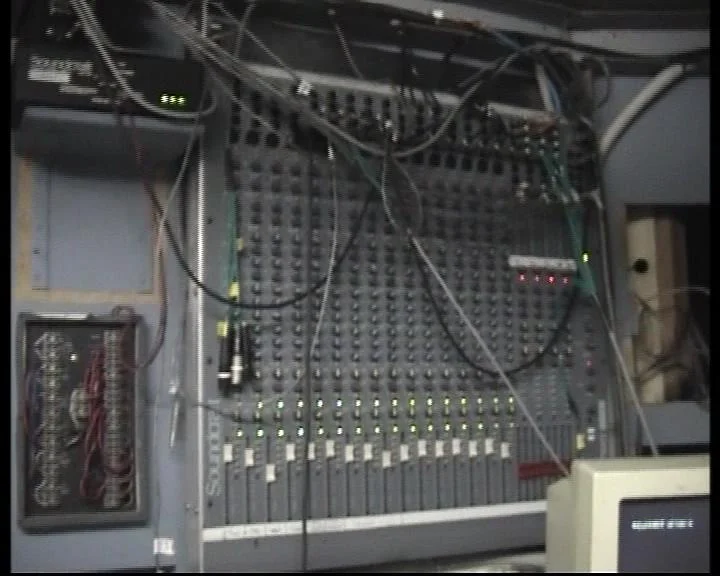
Two Soundcraft 16:8:2 mixers were mounted on the wall of the Space Probe‘s control room because there was no floor space for them. One ran the launch pad and top hat audio; the other controlled the three tunnels and the pre-show room. The equipment rack beside them housed the six PCs that replayed the Channel Seven news footage that took the rider through the whole experience (see Space Probe 7 Delphi Developer), the launch pad amplifiers and the Akai sampler. A PC monitor was patched through a KVM switch to the PCs for resetting them, which had to be done daily. Above the mixer sat its power supply, and below it a series of mounting blocks that distributed audio and power to the speaker boxes in the tunnels. Aluminium side panels fitted to the mixers hinged up so the mixers could be raised parallel to the roof. During construction a six foot long window was cut between the launch pad and the control room so the engineers could see the cabins and talk to the operations panel without leaving the room.
Got a Wonderland story or photos to share?
Join us on Facebook - share memories, photos and stories of Australia's Wonderland with thousands of other fans.
Join Wonderland History on Facebook →